Understanding Health Coverage for the Self-Employed in Bulgaria
When you decide to take the plunge into self-employment in Bulgaria, the sheer joy of autonomy can quickly be overshadowed by the looming questions of administrative duties. One of the biggest, and often most anxiety-inducing, is figuring out your health coverage. Gone are the days when an employer simply handled your social security and health contributions, leaving you to wonder how to navigate the system without that safety net. This guide will walk you through the often-confusing world of health insurance for the self-employed in Bulgaria, ensuring you understand your obligations and options.
The Initial Hurdles: Why Self-Employment Health Coverage Feels Like a Labyrinth
Let's be honest, transitioning from being an employee to being your own boss is exhilarating but also a steep learning curve, especially when it comes to the nitty-gritty of local bureaucracy. Many expats come from countries where social security and health insurance deductions are automatically handled by their employer. The idea of suddenly being responsible for calculating, reporting, and paying these contributions yourself can feel overwhelming, like being dropped into a maze without a map.
The Lone Wolf Mentality vs. Bulgarian Bureaucracy
The freedom of being a freelancer or an independent contractor in Bulgaria is fantastic, offering a lifestyle many of us expats dream of. However, this "lone wolf" mentality often clashes head-on with the structured, often opaque, world of Bulgarian bureaucracy. When you were employed, someone else, typically your HR department or an accountant, dealt with the National Revenue Agency (NRA) and the National Health Insurance Fund (NHIF). They knew the forms, the deadlines, and the specific codes. Now, that responsibility falls squarely on your shoulders.
It's common to feel a sense of frustration and even isolation when trying to decipher these requirements on your own. You're not just running your business; you're also becoming your own payroll and benefits administrator, all while potentially navigating a language barrier. This is a common pain point for many foreigners, and it's completely valid to feel a bit lost. The Bulgarian system, while often straightforward once understood, doesn't always go out of its way to simplify things for newcomers, especially those without an employer advocating for them.
Differentiating Between Employee and Self-Employed Obligations
The fundamental difference in health coverage for employees versus the self-employed in Bulgaria boils down to who is responsible for the contributions. For employees, their employer deducts the necessary health insurance contributions directly from their salary and remits them to the NHIF. It's largely invisible to the employee, a seamless part of their monthly paycheque.
For the self-employed, however, you become responsible for these contributions. This means understanding your legal status – whether you're registered as a sole trader (ЕТ), a freelancer (свободна професия), or a manager of your own company (управител). Each status has slightly different nuances in terms of how contributions are calculated and reported, but the core principle remains: you are now the one making sure those payments reach the NHIF. This shift demands a proactive approach, diligent record-keeping, and a clear understanding of the minimum thresholds and percentages involved. It’s a significant change from the passive deduction method, requiring you to be far more engaged with the financial aspects of your healthcare.
Deciphering the Bulgarian National Health Insurance Fund (NHIF) for the Self-Employed
Alright, let's get into the nitty-gritty of the NHIF, or Национална Здравноосигурителна Каса (NZOK), as it's known locally. For anyone living and working in Bulgaria, understanding the NHIF is paramount, and it's even more crucial when you're self-employed because you're responsible for your own contributions. This isn't just a suggestion; it's a legal obligation for most residents.
Who is Considered Self-Employed by the NHIF?
When we talk about "self-employed" in Bulgaria for health insurance purposes, it's a broader category than you might initially think. The NHIF generally defines a self-employed individual as anyone who is not working under an employment contract but is performing an economic activity that generates income. This includes:
- Sole Traders (ЕТ – Едноличен Търговец): If you've registered a company as a sole proprietor, you fall into this category. This is a common setup for small businesses and individual entrepreneurs.
- Freelancers (Свободна Професия): This is where many digital nomads, consultants, artists, writers, programmers, therapists, and other professionals land. If you've registered yourself with the BULSTAT register as a freelancer, this is your category.
- Managers of Companies (Управители): Even if you own and manage a limited liability company (EOOD or OOD), and you're not formally employed by it but rather acting as its manager, you might have specific self-employed obligations for health contributions, especially if you're taking a manager's remuneration.
- Farmers and Agricultural Producers: Individuals involved in agricultural activities are also often subject to self-employed health insurance rules.
The key thread here is that your income isn't coming from a traditional employer deducting taxes and contributions. Instead, you are seen as the "payer" for your own social and health insurance. It’s essential to clarify your specific legal status with a local accountant, as this will determine the exact calculations and reporting requirements you need to follow with the National Revenue Agency (NRA) and subsequently, the NHIF. Getting your BULSTAT registration in order is usually one of the very first steps, as this unique identification number is crucial for all your self-employed declarations and payments.
Mandatory Contributions and How They're Calculated
Now, for the part that often causes the most head-scratching: the actual calculation and payment of your mandatory health insurance contributions. As a self-employed individual, you are generally required to contribute 8% of your declared monthly income to the NHIF. However, there's a catch: this declared income cannot be lower than a state-mandated minimum monthly threshold, which is adjusted annually. For example, for 2024, the minimum monthly insurable income for self-employed persons is BGN 780. This means that even if your actual income for a given month is less than BGN 780, you still have to pay 8% of BGN 780 as your health contribution.
The actual calculation can get a bit more complex, particularly for freelancers or sole traders who might have fluctuating income. You declare your insurable income through annual tax declarations, but you make monthly provisional payments. Many self-employed individuals opt to pay the minimum required amount each month and then reconcile any differences with their annual tax return.
Here’s a simplified breakdown of the process:
- Registration: First, you need to register with the National Revenue Agency (NRA) as a self-employed person. This usually happens after you've obtained your BULSTAT number. This step is critical because the NRA is the primary body through which all social and health contributions are reported and paid. You can learn more about this process in our guide on How to Register with the National Health Insurance Fund in Bulgaria.
- Monthly Provisional Payments: Each month, you'll pay your health insurance contribution. As mentioned, this is generally 8% of your minimum insurable income or your actual income if it's higher. These payments are due by the 25th of the following month (e.g., January's contribution is due by February 25th).
- Annual Reconciliation: After the end of the calendar year, when you file your annual tax return, you'll declare your actual annual income from your self-employment. Based on this, the NRA will calculate your final annual health insurance contribution. If your monthly provisional payments were less than what you actually owed based on your full year's income, you'll have to pay the difference. If you overpaid, you might be eligible for a refund.
It’s crucial to understand these mandatory contributions because failing to pay them can lead to gaps in your health coverage, which can be a real headache if you suddenly need medical attention. The system is designed to ensure everyone contributes their fair share, and the self-employed have a direct responsibility to manage this. For a deeper dive into the specifics, check out our article on Understanding Mandatory Health Insurance Contributions in Bulgaria.
What the NHIF Covers for Self-Employed Individuals
Once you're diligently paying into the NHIF as a self-employed individual, you gain access to the public healthcare system in Bulgaria, just like any employed person. This is your safety net, covering a range of essential medical services. It's not a free-for-all, of course, but it provides foundational care that can be invaluable.
Generally, the NHIF covers:
- Primary Care: This is your General Practitioner (GP), or личен лекар (lichen lekar). You'll register with a GP, and they are your first point of contact for most health issues. They handle routine check-ups, basic diagnoses, and prescription refills.
- Specialist Consultations: If your GP determines you need to see a specialist (e.g., a cardiologist, dermatologist, or endocrinologist), they will issue a referral. The NHIF then covers a portion of the specialist's fee.
- Hospital Care: This includes admission to a public hospital for necessary treatments, surgeries, and rehabilitation, all within the NHIF contract. Emergency room visits are also covered.
- Laboratory Tests and Diagnostics: Blood tests, X-rays, ultrasounds, and other diagnostic procedures prescribed by your GP or specialist are usually covered.
- Prescription Medications: A significant portion of the cost of many prescription medicines is subsidized by the NHIF, though you'll often pay a co-payment.
- Emergency Medical Care: In true emergencies, you'll be treated, and the NHIF will cover the costs.
It's important to understand that while a significant portion is covered, there are often co-payments (потребителска такса) for doctor visits, specialist consultations, and hospital stays. These are typically small fees per visit or per day in the hospital, but they do add up. Dental care, for instance, has very limited coverage under the NHIF, usually just basic check-ups and extractions, meaning most significant dental work will be out of pocket. For a broader overview of how the system operates, you might find our guide on How Bulgaria's Health System Works: The NHIF and Private Care Explained (2027) incredibly useful. It breaks down the entire structure, helping you understand where your contributions go and what you can expect in return.
Navigating the Payment Process and Avoiding Penalties
Once you grasp what to pay, the next challenge is how to pay. The Bulgarian system, while improving, still relies heavily on specific procedures and deadlines that, if missed, can quickly lead to frustrating consequences. Staying on top of your health contributions as a self-employed expat is a proactive task, not a reactive one.
The Monthly Payment Ritual: Where, When, and How
Making your monthly health insurance payments might seem daunting at first, but once you establish a routine, it becomes a relatively straightforward ritual. The key is consistency and accuracy. Your payments, as a self-employed person, are typically made to the National Revenue Agency (NRA). The NRA then distributes these funds to the relevant social and health insurance funds.
Here’s how most self-employed expats handle it:
- Online Banking: This is by far the most convenient method. Most Bulgarian banks (like DSK, UniCredit Bulbank, Postbank) offer robust online banking platforms. You'll need to set up a payment to the NRA using specific bank transfer details, including their IBAN, BIC, and a payment reason code (код за вид плащане). This code is crucial as it identifies your payment as a health insurance contribution for self-employed persons (it’s usually 561111 for health contributions). You can often save the payment as a template for future use, making monthly transfers much quicker.
- Bank Transfers at a Branch: If you prefer face-to-face interaction or don't use online banking, you can visit any bank branch and fill out a payment slip. Ensure you have all the NRA details and the correct payment code.
- NRA Payment Points: Some larger NRA offices might have cash desks where you can make payments directly. However, this is generally less convenient than online banking.
When to Pay: Health contributions for a given month are due by the 25th of the following month. For example, your contributions for January are due by February 25th. Mark these dates in your calendar! Setting up recurring payments through your online banking can be a lifesaver.
Missing payments can quickly snowball into problems. It’s not just about the monetary penalty; it can also affect your access to medical services. Being diligent with your payments ensures uninterrupted health coverage, which is invaluable for peace of mind. Remember, the annual tax declaration you submit to the NRA also covers the final reconciliation of your health contributions, so keeping accurate records of your monthly payments is essential for that process. Our comprehensive guide on Filing Your Tax Return with the National Revenue Agency in Bulgaria: The Complete Walkthrough (2027) will give you even more context on how these payments integrate with your overall tax obligations.
Dealing with Gaps in Coverage and Reinstatement
Life happens. Maybe you missed a payment due to an oversight, or perhaps you had a period where your income dipped, and you couldn't make the contributions. Whatever the reason, having a gap in your health insurance coverage in Bulgaria can be a significant problem, and it's something you absolutely want to avoid.
When you fail to pay your mandatory health contributions, you lose your status as an "insured person" with the NHIF. This means that if you need to see a doctor, get a prescription, or require any medical treatment that would normally be covered, you will be treated as an uninsured patient. The consequence? You'll have to pay the full cost out-of-pocket, which can quickly become very expensive, even for routine consultations.
How to Reconcile Gaps:
- Identify the Unpaid Months: The first step is to figure out exactly which months you missed payments for. You can usually check your health insurance status online through the NHIF portal (if you have an electronic signature) or by visiting an NRA office.
- Calculate the Backlog: You'll need to pay all outstanding contributions for the missed months, plus any accrued interest or penalties. The penalty is typically a percentage of the unpaid amount and increases the longer you delay.
- Make the Payments: You pay these overdue amounts to the NRA, again using the appropriate payment codes.
- Reinstatement: Once all outstanding amounts (principal and penalties) are settled, your health insurance status will be reinstated. However, there might be a short waiting period, typically 3 consecutive months of paid contributions after the arrears are cleared, before you can fully utilize your NHIF coverage without issues, especially if the gap was significant. This can feel like a frustrating purgatory, where you've paid your dues but can't yet access the benefits.
It's a frustrating cycle that many expats have experienced. You might think, "Oh, it's just one month, no big deal," but it quickly becomes a "big deal" if you find yourself needing urgent medical care. This is particularly stressful for those who get sick shortly after arriving or before their insurance is fully active. If you're wondering What Happens If I Get Sick Before I Register with the NHIF in Bulgaria?, know that you'll be responsible for all costs, so ensuring continuous coverage is paramount. Always prioritize your health contributions, even when your business income fluctuates, to maintain that crucial safety net.
The Role of Private Health Insurance for the Self-Employed
While the NHIF provides essential coverage, many self-employed expats in Bulgaria find that it doesn't quite meet all their needs or expectations. This is where private health insurance steps in, often acting as a crucial complement or, for some, even a primary source of peace of mind.
Why Private Coverage Isn't Just a Luxury
For self-employed individuals, private health insurance in Bulgaria isn't necessarily a luxury; it can be a practical and wise investment. Think of it this way: when you're your own boss, your health is your business. Any significant health issue that takes you out of commission means lost income and potential disruption to your livelihood. Private insurance offers a layer of protection that often goes beyond what the public system can provide.
Here's why many expats opt for it:
- Shorter Wait Times: Public health specialists can have long waiting lists for appointments and procedures. Private clinics generally offer much quicker access, which is invaluable when you need timely diagnosis and treatment.
- Access to English-Speaking Doctors: While you can certainly How to Find an English-Speaking Doctor in Bulgaria within the public system, private clinics and hospitals are more likely to have a higher concentration of English-speaking staff, making communication much easier and less stressful during vulnerable moments.
- Wider Choice of Clinics and Hospitals: Private insurance opens up a broader network of modern, well-equipped private hospitals and clinics, particularly in major cities like Sofia, Plovdiv, and Varna. These facilities often boast state-of-the-art equipment and more comfortable patient environments.
- More Comprehensive Services: Many private plans cover services that the NHIF either doesn't cover or covers minimally, such as extensive dental work, optical care, some mental health services, and certain alternative therapies. If you're looking for more holistic or preventative care, private insurance often provides better options.
- Direct Billing: A huge benefit of many private plans is direct billing. Instead of paying out-of-pocket and then claiming reimbursement from the NHIF (which can be a process), private insurers often pay the clinic or hospital directly, reducing your administrative burden and immediate financial outlay.
- Peace of Mind: Perhaps the most significant advantage is the peace of mind. Knowing you have access to prompt, high-quality care, often without the bureaucratic hurdles of the public system, allows you to focus on your work and enjoy life in Bulgaria without constant worry about potential health issues.
For someone whose income depends entirely on their ability to work, minimizing downtime due to health issues and accessing the best possible care quickly can be an absolute game-changer.
Choosing the Right Private Plan
Selecting a private health insurance plan can feel like another complex decision, given the variety of options available. It’s not just about picking the cheapest one; it's about finding coverage that genuinely aligns with your specific needs, lifestyle, and budget.
When you're shopping for private health insurance, especially as a self-employed expat, consider these key factors:
- Coverage Limits: Understand the maximum payouts for different categories – inpatient, outpatient, specialist visits, diagnostics, etc. Does it cover the big things (like surgery or serious illness) as well as the routine stuff?
- Network of Providers: Does the insurer have agreements with the hospitals and clinics you prefer or that are conveniently located near you? Some plans restrict you to a specific network, while others offer more flexibility. Leading private hospitals in Sofia like Acibadem City Clinic Tokuda Hospital or Hill Clinic are often part of these networks.
- Direct Billing vs. Reimbursement: As mentioned, direct billing is a huge convenience. Confirm if your chosen plan offers this, or if you'll need to pay upfront and then submit claims for reimbursement.
- Exclusions and Limitations: Read the fine print! Are there specific conditions or treatments that are not covered? What about pre-existing conditions? Travel insurance, for example, often excludes existing conditions or long-term care needs.
- Geographic Coverage: For digital nomads or those who travel frequently, a plan that offers international coverage can be invaluable. This is where options like SafetyWing shine. If you're regularly hopping between countries for work or leisure, a traditional local Bulgarian private plan might only cover you within Bulgaria. SafetyWing, designed for remote workers, offers worldwide medical coverage, including Bulgaria, and also covers travel delays and other travel-related incidents, making it a comprehensive choice for the truly mobile. This dual coverage for health and travel makes it particularly appealing for its target demographic.
- Customer Service and Language Support: Can you easily communicate with the insurer in English? Is their claims process straightforward?
Comparing different providers, such as Allianz, Generali, or a more expat-focused option, is crucial. Don't be afraid to ask for detailed breakdowns and clarifications. Our guide on Understanding Private Health Insurance Plans in Bulgaria can give you a solid foundation for evaluating your options, and if you're a newcomer, you might find How to Buy Private Health Insurance as a Newcomer in Bulgaria helpful for those initial steps.
Blending Public and Private: The Hybrid Approach
For many self-employed expats, the most practical and cost-effective approach to healthcare in Bulgaria is a hybrid model – combining your mandatory NHIF coverage with a supplementary private health insurance plan. This strategy allows you to leverage the strengths of both systems while mitigating their individual weaknesses.
Here’s how this blend often works in practice:
- NHIF as Your Foundation: You continue to make your mandatory NHIF contributions, ensuring you comply with Bulgarian law and maintain access to the fundamental public healthcare network. This covers your basic GP visits, essential specialist referrals, and emergency care at public hospitals. It’s your safety net for core services.
- Private Insurance for Enhanced Access and Specific Needs: Your private plan then steps in to fill the gaps and provide a higher level of convenience and choice.
- Specialists and Diagnostics: Instead of waiting weeks for an NHIF-referred specialist appointment, you can use your private insurance to book an appointment directly with a private specialist at your preferred clinic, often within days. The same goes for faster access to advanced diagnostics like MRIs or CT scans.
- Dental and Optical: Since NHIF coverage for dental and optical is minimal, private insurance often covers a significant portion of these costs, making routine check-ups and necessary treatments much more affordable.
- Comfort and Language: For hospital stays or complex treatments, private insurance can grant you access to private rooms, more personalized care, and a higher probability of English-speaking medical staff, significantly reducing stress during a difficult time.
- Emergency Care (with caveats): While the NHIF covers public hospital emergencies, a private plan might offer access to private emergency facilities or quicker transfer options, depending on the policy.
Consider a hypothetical scenario: You wake up with a severe earache. Your NHIF GP might be able to see you in a couple of days, or refer you to an ENT specialist with a two-week wait. With private insurance, you could call a private clinic, get an appointment with an English-speaking ENT specialist that very afternoon, and get a diagnosis and prescription much faster. For something more routine like a blood test, you might go through your NHIF GP to keep costs down.
This hybrid approach ensures you meet your legal obligations while giving you the flexibility and quality of care that private insurance affords. It’s about being strategic with your healthcare, making sure you have the best possible coverage without breaking the bank.
Specific Scenarios and Common Expat Questions
Moving to a new country and setting up as self-employed is full of unique questions, and health coverage is no exception. Let's tackle some common scenarios and concerns that frequently pop up for expats navigating the Bulgarian system.
New to Self-Employment in Bulgaria: Your First Steps
So, you've just arrived in Bulgaria, eager to set up your freelance business or sole proprietorship. Congratulations! But before you dive into client work, getting your health coverage sorted is paramount. It can feel like a chicken-and-egg situation – do you need a business first, or insurance? Here’s a pragmatic, step-by-step guide for your initial journey:
-
Register Your Legal Status: Your very first step is to establish your legal status as self-employed.
- BULSTAT Registration: This is often the starting point. Whether you’re registering as a freelancer (свободна професия) or a sole trader (ЕТ), you’ll need to apply for a BULSTAT number. This is a unique identification number that acts as your registration with the Bulgarian statistics office and is critical for all subsequent administrative steps. It's usually done at the Registry Agency.
- NRA Registration: Once you have your BULSTAT, you'll need to register with the National Revenue Agency (NRA). This is where you'll declare your self-employed status for tax and social security purposes. This ensures the NRA knows you’re an independent contributor. Our article on How Do I Register as a Freelancer in Bulgaria? provides a more detailed walkthrough of this critical initial phase.
-
Declare Provisional Contributions: As soon as you're registered with the NRA, you're expected to start making provisional monthly health insurance contributions. Even if you don't have income immediately, you'll need to pay based on the minimum insurable income threshold. This is a crucial detail many new self-employed individuals overlook, leading to gaps from the very start.
- Proactive Payment: Don't wait for a bill. You are responsible for initiating these payments by the 25th of the month following the contribution period.
-
NHIF Access: Once your contributions start, you gain access to the NHIF. You will then need to choose and register with a General Practitioner (GP) who is contracted with the NHIF. This GP becomes your primary point of contact for all public healthcare services.
A word of caution: Your residence status in Bulgaria also dictates your eligibility and requirements for NHIF enrolment. EU citizens have different registration procedures than non-EU citizens, who usually need a Type D visa and a temporary residence permit before they can even contemplate registering for NHIF. Understanding How Your Residence Status Affects NHIF Enrolment in Bulgaria is key to avoiding delays or rejection. Always seek professional advice from a local accountant or legal professional to ensure your specific situation is handled correctly from day one.
Self-Employed with Family: Extending Your Coverage
For self-employed expats with families, healthcare becomes an even more pressing concern. You're not just thinking about your own well-being but also that of your loved ones. The good news is that under Bulgarian law, if you are a self-employed individual paying NHIF contributions, your minor children (under 18, or up to 26 if they are full-time students) are typically covered under your NHIF status. This provides a basic level of public healthcare for them, including access to a pediatrician and subsidized prescriptions.
However, extending NHIF coverage to your spouse or other adult dependents is usually not as straightforward as it would be if you were formally employed. Generally, adult dependents (including spouses) are expected to make their own health insurance contributions if they are not employed or self-employed themselves. They can register as uninsured persons who wish to pay health insurance on their own behalf (самоосигуряващо се лице), paying the minimum required amount each month. This is a significant distinction from many other countries where family coverage is automatically bundled.
Given this, many self-employed expats with families opt for comprehensive private health insurance. A private family plan can offer several advantages:
- Unified Coverage: A single private policy can cover the entire family, simplifying administration and ensuring everyone has access to the same high-quality care.
- Wider Choice for All: Everyone benefits from shorter wait times, access to English-speaking doctors, and a broader network of private clinics and hospitals. This is especially valuable for children, where access to specific pediatric specialists without delay can be crucial.
- Additional Benefits: Family private plans often include benefits like enhanced dental and optical care for all members, mental health support, and maternity care that may be more extensive than public offerings.
- International Mobility: If your family travels frequently, a private plan with international coverage can provide peace of mind wherever you are.
While it means an additional cost, the ease, comprehensiveness, and peace of mind that a private family plan provides often make it a worthwhile investment for self-employed expats in Bulgaria. You can find more details on general family coverage in our guide on How to Add Dependents to Your Health Coverage in Bulgaria, but always remember to double-check the specifics for self-employed individuals with an accountant.
Cross-Border Considerations for Digital Nomads and Frequent Travellers
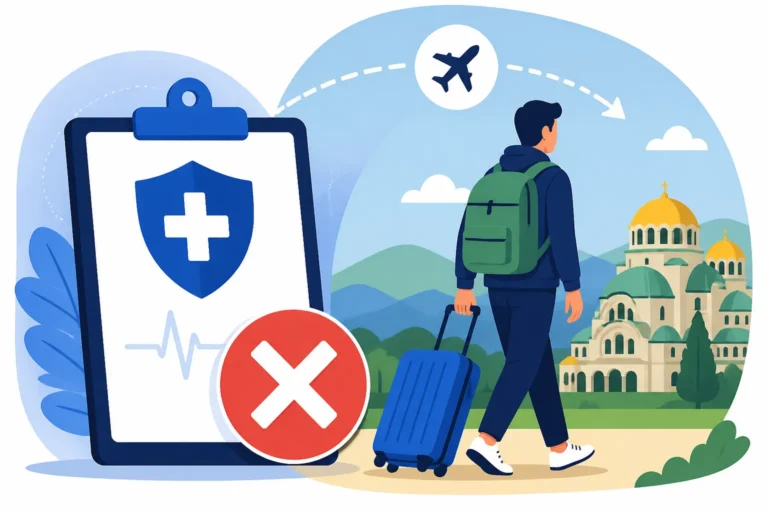
Bulgaria is a magnet for digital nomads and expats who love to travel, but this lifestyle adds another layer of complexity to health coverage. Your Bulgarian NHIF status is primarily for healthcare within Bulgaria. While it's part of the EU system, its utility abroad is specific and limited.
Here’s what you need to know:
- The EHIC (European Health Insurance Card): If you are an EU citizen and are fully insured with the Bulgarian NHIF, you can apply for an EHIC. This card allows you to receive medically necessary state-provided healthcare during a temporary stay in any EU country, Iceland, Liechtenstein, Norway, or Switzerland. However, it only covers you for emergencies or treatments that cannot wait until your return to Bulgaria, and it’s always based on the rules and costs of the country you're visiting. It’s not a substitute for travel insurance and won't cover things like medical repatriation or non-urgent treatments. For non-EU citizens, the EHIC is generally not applicable, even if you’re resident and paying into the NHIF in Bulgaria.
- Limitations of NHIF Outside Bulgaria: Your Bulgarian NHIF does not cover you for planned medical tourism, non-urgent care, or any healthcare outside of the specific terms of the EHIC in non-EU/EEA countries. If you get sick in, say, Thailand or Mexico, your Bulgarian public insurance offers no coverage.
- The Necessity of Travel Health Insurance: For digital nomads and frequent travelers, robust travel health insurance is not just recommended; it’s essential. This is where specialized providers come in. For example, SafetyWing is a popular choice among digital nomads because it provides health coverage worldwide (with certain exclusions like the US for non-residents or specific high-risk zones) while also offering travel insurance benefits. It’s designed for the flexibility of remote work and covers medical emergencies, travel delays, lost luggage, and more, specifically addressing the needs of those who spend significant time outside their home country or primary residence. It ensures that no matter where your work takes you, you’re protected.
By understanding these distinctions, you can ensure that your health coverage travels with you, offering peace of mind whether you're working from your apartment in Sofia, exploring the Bulgarian mountains, or jet-setting to another continent for your next adventure. Don't rely solely on your NHIF if you plan to be a truly global citizen; invest in comprehensive international travel health insurance.
NHIF vs. Private Health Insurance for the Self-Employed in Bulgaria
Here’s a quick comparison to help you understand the core differences and make informed decisions about your health coverage.
| Feature | National Health Insurance Fund (NHIF) | Private Health Insurance |
|---|---|---|
| Mandatory Status | Mandatory for most legal residents (including self-employed) | Optional, supplementary coverage |
| Cost | Fixed percentage (8%) of declared insurable income (min. BGN 780 in 2024), plus co-payments | Varies widely based on coverage, age, provider, and benefits |
| Coverage Scope | Primary care, specialist referrals, public hospital care, some meds, emergencies | Often broader: comprehensive dental, optical, mental health, private hospitals, elective procedures |
| Access Speed | Can involve waiting lists for specialists and non-urgent procedures | Generally faster access to specialists and appointments |
| Doctor Choice | Limited to NHIF-contracted GPs and specialists | Wider choice of doctors and clinics, often including English-speaking ones |
| Facility Access | Public hospitals and clinics | Private hospitals and clinics, often with modern facilities |
| Language Support | Primarily Bulgarian, some English-speaking doctors available | More likely to find English-speaking staff and customer support |
| International | EHIC for temporary stays in EU/EEA (for EU citizens), otherwise no coverage | Can offer worldwide coverage, often includes travel benefits |
| Administration | Managed via NRA payments, annual tax declarations, GP registration | Direct with insurer, potentially direct billing or reimbursement |
| Peace of Mind | Basic safety net, legal compliance | Enhanced peace of mind, greater control, comprehensive care |
Disclaimer
The information provided in this guide is for general informational purposes only and does not constitute professional financial, legal, or medical advice. While we strive to keep the information up-to-date and accurate, regulations in Bulgaria can change rapidly. Always consult with a qualified Bulgarian accountant, legal professional, or insurance advisor for advice tailored to your specific situation before making any decisions regarding your health coverage or financial obligations as a self-employed individual in Bulgaria.