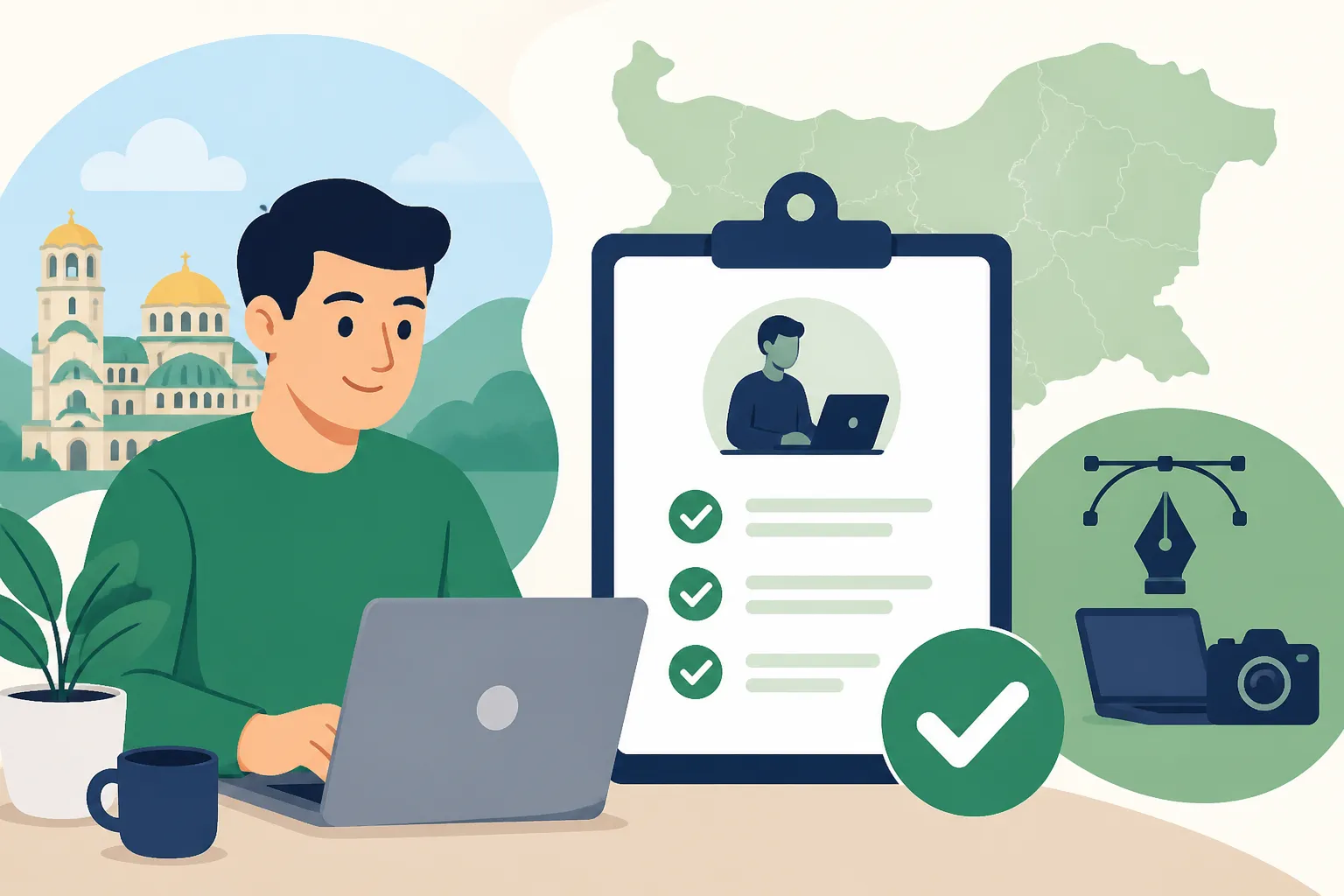
How to Register as a Freelancer (Свободна Професия) in Bulgaria
Oh, the joy of setting up your own thing in Bulgaria! For many of us expats, the dream of working for ourselves, offering our skills and services independently, is a huge draw to this beautiful country. But then reality hits: the paperwork, the unfamiliar terms, the ever-present feeling of "am I doing this right?" Registering as a freelancer, or as it's known here, "Свободна Професия" (Svobodna Profesiya), can feel like navigating a maze blindfolded. This guide is here to be your friendly, experienced companion, walking you through every twist and turn of becoming a legally recognised independent professional in Bulgaria, without the headache.
Understanding "Свободна Професия": What Exactly is a Freelancer in Bulgaria?
Alright, let's cut to the chase and understand what we're actually talking about here. In Bulgaria, if you're offering professional services independently, without forming a company, you'll generally fall under one of two main categories: "Свободна Професия" (Svobodna Profesiya), which translates to "liberal profession" or "freelancer," or "Едноличен търговец" (Ednolichen Targovets – ET), which is essentially a sole trader. While both allow you to work for yourself, there are crucial distinctions, especially for expats, that can make a huge difference in how you operate and what your obligations are.
Defining "Свободна Професия" vs. Sole Trader (ET)
The core difference often boils down to the nature of your work. "Свободна Професия" is typically reserved for individuals who provide intellectual services or services that require specific professional qualifications, often regulated by law. Think doctors, lawyers, architects, accountants, translators, journalists, IT specialists, artists, consultants, and even yoga instructors or psychotherapists. The emphasis is on personal skill and expertise. You're selling your brain, your hands, your knowledge directly. You, as an individual, are the business.
On the other hand, an "Едноличен търговец" (ET), or sole trader, is generally for commercial activities, trading goods, or offering services that might involve more operational overhead or have a broader commercial scope. While there can be some overlap, an ET is often seen as a small business entity, even though it's still operated by a single individual. For example, if you're running a small shop, a guesthouse, or a repair service, you'd likely register as an ET. The distinction isn't always crystal clear, and sometimes a professional accountant's advice is invaluable here, as choosing the wrong status can lead to unnecessary complications down the line. It's really about how the Bulgarian legal system categorises your specific activities.
Common Professions that Fall Under "Свободна Професия"
Many expats find themselves perfectly suited for the "Свободна Професия" status because their skills often align with these "liberal professions." the status suits many people — from graphic designers and web developers coding away in their Plovdiv apartments, to English teachers giving lessons online, to writers crafting content for international clients from a seaside town near Varna – successfully operate under this status. Translators, proofreaders, marketing consultants, private tutors, and even personal trainers often find themselves in this category. The key is that your service is primarily intellectual, artistic, or professional, relying on your personal expertise rather than a large-scale commercial operation.
For instance, if you're teaching English via a platform like iTalki, providing private lessons to Bulgarian students, or offering freelance writing services, "Свободна Професия" is almost certainly the path for you. It simplifies a lot of the initial setup compared to an ET, as it focuses on you, the individual professional, rather than a more complex business structure.
Key Advantages and Disadvantages of This Status
Okay, so why choose "Свободна Професия"? Well, for starters, it's generally much simpler to set up and manage compared to an ET or a limited company (EOOD/OOD). The administrative burden is lighter, and the accounting requirements are less complex. This means potentially lower costs for accountants and fewer headaches with reporting. Another huge advantage is the flat 10% personal income tax rate, which is very attractive, especially if you're coming from a country with progressive tax rates that climb much higher. This straightforward tax system is one of the big draws for many digital nomads and freelancers considering Bulgaria. You can read more about Understanding the Flat 10% Personal Income Tax in Bulgaria to get a clearer picture of how beneficial this can be.
However, it's not all sunshine and roses. One potential downside is that "Свободна Професия" status offers limited liability. As an individual, your personal assets are generally not separate from your professional liabilities. This means if something goes wrong, you could be personally responsible. While this is less of a concern for many intellectual professions, it's something to be aware of. Also, while the initial setup is easier, some ongoing administrative tasks, especially around social security and health contributions, require attention and precision. While not overly complicated, it's certainly not something you can just ignore.
| Feature | Свободна Професия (Freelancer) | Едноличен търговец (ET – Sole Trader) |
|---|---|---|
| Nature of Activity | Intellectual, professional services (e.g., IT, consulting, art) | Commercial activities, trade, wider range of services |
| Setup Complexity | Generally simpler | Slightly more complex, closer to a small business |
| Taxation | Flat 10% Personal Income Tax on adjusted income | Flat 10% Corporate Tax for profit (similar effective rate) |
| Liability | Unlimited personal liability | Unlimited personal liability |
| Accounting | Simpler record-keeping, cash-based often | More detailed accounting requirements |
| Registration | BULSTAT register, NRA | Commercial Register (Агенция по вписванията), NRA |
| Social Security | Self-employed contributions (fixed minimum) | Self-employed contributions (fixed minimum) |
The Absolute Must-Haves Before You Start: Preparation is Key
Before you even think about stepping into an office or filling out a form, you need to get your ducks in a row. Believe me, trying to wing it in the Bulgarian administrative system is a recipe for stress and delays. Think of this preparation phase as laying the groundwork for a smooth sailing freelance career. This is where you gather your ammunition and find your allies.
Essential Documents and Their Bulgarian Equivalents
First things first, you'll need your personal identification documents. Your valid passport, naturally, and your Bulgarian residence permit. If you're an EU citizen, your certificate of registration is key. For non-EU citizens, your long-stay (Type D) visa and residence permit will be paramount. Beyond that, you'll need proof of address in Bulgaria – usually your rental contract or a declaration from your landlord. Make sure everything is current, and it's always a good idea to have several copies, both digital and physical. You might also need certain professional qualifications or diplomas if your profession is regulated, and often these will need to be officially translated and apostilled. Navigating Understanding Document and Translation Requirements for Bulgaria Immigration might give you some insight into the level of detail required for official papers here.
It’s crucial to understand that Bulgarian authorities often want to see original documents or certified copies. Don't assume photocopies will suffice, even if they're colour. Always ask your accountant or a trusted local advisor exactly what kind of copies or certifications are needed for each step of the process.
Finding a Good Accountant: Your Lifeline in Bulgarian Bureaucracy
This is, hands down, the most important piece of advice I can give you: get a good accountant. Seriously. For expats, especially, a Bulgarian accountant isn't just someone who crunches numbers; they are your translator, your guide, and often your shield against bureaucratic confusion. They know the ins and outs of the constantly shifting tax laws, they speak the language, and they know which window to go to and which person to talk to. Trying to register as a "Свободна Професия" without one is like trying to build IKEA furniture with a blindfold and no instructions – possible, but infinitely more frustrating.
Your accountant will advise you on the specifics of your profession, help you obtain your BULSTAT number, register you with the National Revenue Agency (NRA) and the social security institutions, and ensure you're making the correct monthly and annual declarations. Many firms, like those recommended by "Taxes for Expats", specialise in foreign clients and often have English-speaking staff, which is a godsend. Don't cheap out here; a good accountant saves you time, money, and monumental stress. They'll also clarify nuances like How Do I Register My Freelance Income for Tax in Bulgaria? and help you avoid common pitfalls.
Obtaining a BULSTAT Number: Your First Official Step
Once you have your documents in order and, ideally, an accountant on board, your very first official step towards becoming a "Свободна Професия" is obtaining a BULSTAT number. This is a unique identification number for non-legal entities, including freelancers and sole traders, and it's issued by the Registry Agency (Агенция по вписванията). Think of it as your unique ID in the Bulgarian business world. Without it, you can't register with the NRA or pay your contributions.
Your accountant will almost certainly handle this for you, but it's good to understand the process. You'll need to submit an application form, along with copies of your ID documents (passport, residence permit), proof of address, and potentially a document proving your professional qualification if applicable. The application is typically filed at the Registry Agency office in your regional capital (e.g., Sofia, Plovdiv, Varna). The process usually takes a few working days, and once you have that precious BULSTAT, you’re officially on the grid! This is a crucial step detailed further in How Do I Get a Tax ID (BULSTAT) as a Foreigner in Bulgaria?.
Step-by-Step Registration with the National Revenue Agency (NRA)
With your BULSTAT number in hand and your trusted accountant by your side, the next major hurdle is registering with the National Revenue Agency (NRA – Национална агенция за приходите). This is where you officially declare your intention to operate as a self-employed professional and begin your tax and social security journey. It might sound intimidating, but with the right guidance, it’s entirely manageable.
The Initial Application and Required Forms
After getting your BULSTAT, your accountant will assist you in filling out the necessary registration forms for the NRA. The main form you’ll be concerned with is typically Form 1 (Образец 1), which is used for initial registration as a self-insured person. This form officially declares your intention to pay social and health insurance contributions as a freelancer. This is not something you want to get wrong, as incorrect declarations can lead to problems later on. Your accountant will ensure all details are correct, including your BULSTAT number, personal details from your ID, and the type of activity you’ll be engaging in.
Upon submission of these forms, you’ll be officially registered with the NRA as a self-insured person under your "Свободна Професия" status. This means the state now knows you exist as an independent worker, and you’re ready to start fulfilling your obligations. This step is critical for ensuring you're compliant from day one, setting the stage for smoother operations.
Registering for Social and Health Insurance Contributions
Now that the NRA knows you’re a freelancer, it’s time to talk about contributions. In Bulgaria, as a self-employed individual, you are legally obligated to make monthly social and health insurance contributions. This is not optional, and it's fundamental to being a legal resident here. These contributions cover things like your pension, general illness and maternity, and access to public healthcare.
Your accountant will set up your initial declaration for these contributions. The amount you pay is based on a minimum monthly insurable income, which is set by the state annually. This amount tends to increase slightly each year, so it’s something your accountant will keep you informed about. These contributions are usually paid by the 25th of the following month. For example, your contributions for January would be due by February 25th. Understanding How much are Health Insurance Contributions for Freelancers in Bulgaria? is vital, as this is a recurring monthly cost you must factor into your finances. These payments are crucial for your access to the public healthcare system, which you can learn more about in How Bulgaria's Health System Works: The NHIF and Private Care Explained (2027).
Understanding the Tax Implications and Flat Tax Rate
This is often the most appealing part for freelancers in Bulgaria: the flat 10% income tax rate. Once you're registered as a "Свободна Професия," your taxable income is calculated after deducting certain expenses. For freelancers, the law allows for a 25% standard deductible expense on your gross income for most activities. This means you only pay income tax on 75% of your earnings. For certain artistic or cultural professions, this deduction can be even higher, up to 40%.
So, if you earn 1000 BGN, you deduct 250 BGN, and pay 10% tax on the remaining 750 BGN, which is 75 BGN. This straightforward calculation makes financial planning much simpler. However, you'll still need to keep good records of your income. Your accountant will help you understand the nuances of Understanding the Flat 10% Personal Income Tax in Bulgaria and ensure you’re correctly calculating your taxable base and making your annual declarations. This simplified tax system is definitely one of Bulgaria's major advantages for independent professionals.
Navigating the Bank Account and Payment Systems
Now that you're officially registered and understand your tax obligations, let's talk about the practical side of managing your money: banking and payments. This might seem mundane, but getting it right from the start can save you a lot of hassle and ensure smooth financial operations for your freelance work.
Opening a Business Bank Account (or Using a Personal One for Starters)
When you’re a "Свободна Професия," you generally don't strictly need a separate business bank account right away, unlike a registered company (EOOD/OOD). Many freelancers, especially when starting out, simply use their personal bank account for their freelance income and expenses. However, I strongly recommend opening a separate personal account dedicated only to your freelance income and expenses. This makes tracking everything for your accountant and for your own records infinitely easier, especially when it comes to separating personal finances from business earnings.
If you prefer a more formal approach, or as your business grows, you can open a dedicated business account. Major Bulgarian banks like DSK Bank, UniCredit Bulbank, and Raiffeisenbank are popular choices among expats. The process is similar to opening a personal account but might require your BULSTAT number and proof of your "Свободна Професия" registration. You can find detailed steps and tips in How to Open a Bank Account at a Bulgarian Bank as a Foreigner or the broader The Expat Guide to Opening a Bank Account in Bulgaria. Always ask about fees for incoming international transfers if most of your clients are abroad, as these can add up.
Receiving Payments from Clients: Local and International Transfers
Receiving money from your clients, whether they're down the street in Sofia or halfway across the globe, is crucial. For local clients, bank transfers are standard. For international clients, you have several options. Traditional bank wires (SWIFT transfers) are always an option, but they can be slow and incur higher fees, especially for smaller amounts. Many expats prefer using online money transfer services such as Wise (formerly TransferWise) or Revolut, which often offer better exchange rates and lower fees for international transactions. PayPal is also widely used, though its fees can sometimes be higher for business transactions.
When providing your payment details, ensure you give your clients your full name (as it appears on your bank account), your IBAN, BIC/SWIFT code, and the bank's full name and address. If you're using a multi-currency account with services like Wise, you might even have local bank details in other currencies, which can simplify payments for international clients and potentially reduce their transfer costs. It's also vital to ensure that your clients' payment methods comply with Bulgarian financial regulations, especially for larger sums.
Record Keeping and Invoicing: Staying Compliant
This is where your inner organised guru needs to shine (or your accountant's, at least!). As a "Свободна Професия," you are required to issue documents for your services. The most common document is an invoice (фактура) or a receipt (касова бележка) if you have a cash register, though most freelancers dealing with other businesses or international clients will use invoices. Your invoices must contain specific information: your full name, BULSTAT number, address, the client's details, description of services, date, amount, and VAT status (more on VAT in a moment).
Even if you’re not VAT-registered, you must still issue proper invoices. Keep digital and physical copies of all your outgoing invoices and incoming expense receipts. These records are crucial for your accountant to prepare your monthly declarations and your annual tax return. Imagine explaining a year's worth of income and expenses without any documentation – it's a nightmare scenario! Good record-keeping makes your tax life so much easier and helps you stay compliant, as discussed in Filing Your Tax Return with the National Revenue Agency in Bulgaria: The Complete Walkthrough (2027).
Ongoing Obligations and Responsibilities as a Bulgarian Freelancer
Once you're set up and making a living, the journey doesn't end. Being a "Свободна Професия" in Bulgaria comes with ongoing responsibilities. It’s not just about earning money; it’s about consistently fulfilling your legal and financial duties. This requires a certain level of diligence, but again, a good accountant will be your best friend here.
Monthly and Quarterly Declarations and Payments
As a freelancer, your primary ongoing obligation will be your social and health insurance contributions, which are paid monthly. Your accountant will usually prepare the payment orders, and you'll transfer the funds from your bank account to the respective NRA accounts by the 25th of the following month. For example, contributions for March are due by April 25th.
Beyond these monthly payments, depending on your income level, you might also be subject to quarterly advance payments for your income tax. If your expected annual taxable income exceeds a certain threshold, you'll pay advance income tax by the 25th of the month following the end of each quarter (i.e., April 25th, July 25th, October 25th). However, this is usually reconciled during your annual tax return. For many starting freelancers, these quarterly payments might not apply initially, but it’s something to be aware of and discuss with your accountant. They are key to understanding How Your Residence Status Affects NHIF Enrolment in Bulgaria.
Annual Tax Returns and Deadlines
Every year, by April 30th, all individuals, including "Свободна Професия" freelancers, must file an annual tax return with the National Revenue Agency. This is where all your income from the previous calendar year is declared, your deductions are applied, and your final tax liability is calculated. If you've made advance quarterly payments, these will be factored in, and you'll either owe more tax or be due a refund.
This annual declaration is comprehensive. It includes your freelance income, any other personal income (e.g., rental income, income from abroad), and your social and health contributions for the year. This is a critical document, and filing it correctly is paramount. This is another area where your accountant's expertise is invaluable, especially when dealing with foreign income, as they'll ensure you benefit from any double taxation agreements Bulgaria might have with your home country. For a deeper dive, check out How to File Your Annual Tax Return in Bulgaria.
Renewing Documents and Staying Up-to-Date
Bulgaria's administrative landscape, while generally stable, does see occasional changes in regulations, minimum contribution amounts, or deadlines. It's essential to stay informed, and again, a good accountant will usually notify you of any relevant updates. Your residence permit, which is foundational to your ability to work and live here, will need regular renewal, typically annually or every few years. Ensure you keep an eye on its expiry date and begin the renewal process well in advance to avoid any gaps in your legal status.
Furthermore, if your professional qualifications require periodic renewal or registration with a specific professional chamber or association, make sure you comply with those requirements. For instance, a licensed architect or a certified translator might have additional obligations to their respective professional bodies. These renewals ensure your "Свободна Професия" status remains valid and fully compliant with all Bulgarian laws.
Common Challenges and Insider Tips for Expats
It is worth knowing that while the "Свободна Професия" path is generally straightforward, it's not entirely without its quirks. There are common hurdles that many foreigners face, and knowing about them beforehand, along with some insider tips, can make your journey significantly smoother.
Language Barriers and Where to Find Help
Let's be honest, Bulgarian is not the easiest language to pick up, especially when it comes to legal and administrative jargon. This is arguably the biggest challenge for new expats trying to set up their freelance life. While many younger Bulgarians in major cities speak English, government offices are often a different story. Don't expect civil servants to be fluent, or even willing, to conduct business in English. This language barrier can lead to misunderstandings, incorrect form completion, and immense frustration.
This is precisely why a good, English-speaking accountant is a non-negotiable asset. They act as your primary liaison. Beyond that, consider investing a bit of time in learning some basic Bulgarian, especially phrases related to numbers, dates, and common greetings. Even a small effort goes a long way. There are plenty of resources online, and platforms like iTalki can connect you with Bulgarian tutors for very affordable rates. Having a friend or a professional translator accompany you to important appointments can also be a lifesaver.
Dealing with Bureaucracy: Patience and Persistence
Ah, Bulgarian bureaucracy. It has a reputation, and sometimes it lives up to it. Things might move slowly. You might be asked for a document you weren't told about previously. You might visit three different windows to achieve one small thing. This isn't unique to Bulgaria, of course, but for expats used to more streamlined processes, it can be a shock.
My best advice? Patience and persistence. Take a deep breath. Don't get visibly frustrated; it rarely helps. Assume that things will take longer than you expect, and bring all the documents you think you might need, plus a few extra copies. A calm, respectful demeanour, combined with meticulous preparation, is your best strategy. Remember that civil servants are just doing their jobs, often with limited resources, and sometimes a friendly smile and a polite request for clarification can work wonders.
Networking and Finding Clients in Bulgaria
While many freelancers operate internationally, if you're looking to find clients within Bulgaria, networking is key. Bulgarians often value personal connections and referrals. Attend expat meetups, join local business groups (many have English-speaking members), and don't be afraid to put yourself out there. Platforms like LinkedIn are increasingly popular for professional networking in Bulgaria.
If your services cater to the local market, consider having some basic marketing materials translated into Bulgarian. For example, if you're a web designer, having your portfolio site in both English and Bulgarian can expand your reach significantly. Think about niche expat groups or businesses that cater to foreigners; they might be a great starting point for finding your first local clients. The Bulgarian economy, particularly in cities like Sofia and Plovdiv, has a growing demand for diverse professional services, offering ample opportunities for enterprising expats.
Disclaimer
Please remember that I am an expat blogger sharing my personal experiences and general advice. While I strive to provide accurate and up-to-date information, rules and regulations in Bulgaria, especially concerning immigration, taxation, and business registration, can change. This guide should not be considered legal or financial advice. Always consult with a qualified Bulgarian lawyer or accountant for advice tailored to your specific situation and circumstances.