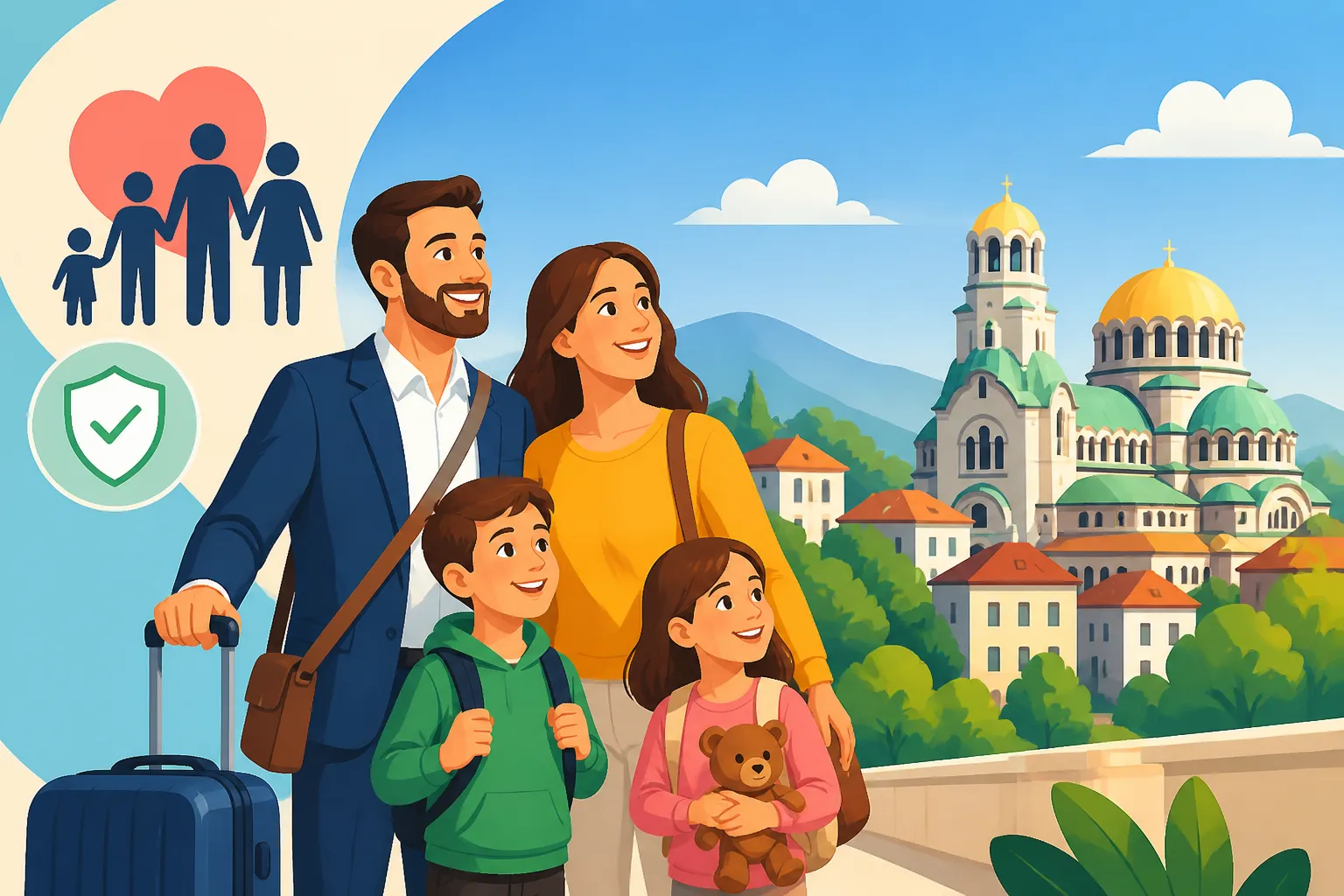
Can I Bring My Family When I Move to Bulgaria for Work?
One of the biggest concerns for anyone considering a move to a new country for work is the well-being and inclusion of their family. The administrative hurdles of relocating yourself are challenging enough, but adding spouses and children to the mix can feel overwhelming, sparking fears that your loved ones might be left behind in the complex Bulgarian immigration system. This guide is here to tell you that bringing your family to Bulgaria for work is absolutely possible, and we'll walk you through the precise steps and realities you'll encounter along the way.
Understanding Bulgarian Family Reunification for Work Permit Holders
So, you’ve secured a job in Bulgaria, perhaps even your Single Permit, and now your mind immediately turns to your spouse and children. The good news is that Bulgarian law does provide pathways for family reunification. This isn't just a nicety; it's a fundamental recognition that expats don't live in a vacuum and need their loved ones with them. However, it's not a simple wave of a magic wand, either. It requires patience, meticulous documentation, and understanding a multi-step process.
For those of us coming from outside the EU/EEA, the primary mechanism you’ll be relying on is the family reunification provision under the Bulgarian Aliens Act. This allows certain family members of a foreign national who holds a valid long-term or permanent residence permit to apply for their own residence permits. Essentially, your success in securing your own work-based residence becomes the foundation upon which your family's applications are built. Without your primary permit firmly in hand, their process cannot begin in earnest. Think of it as a domino effect, where your first domino has to fall perfectly for the others to follow.
Who Qualifies for Family Reunification?
When we talk about "family," the Bulgarian authorities have a clear definition for the purpose of reunification. Generally, this includes:
- Your Spouse: This is usually the most straightforward, provided you have a legally recognised marriage certificate. Common-law partners or unmarried couples, while common in many Western societies, often face significant hurdles or may not be recognised for family reunification in Bulgaria, making a legal marriage the most secure route.
- Minor Children: This covers children under the age of 18, including adopted children. Both your biological children and those of your spouse (if you are the primary permit holder) are typically eligible.
- Dependent Adult Children: In very specific circumstances, adult children (over 18) who are financially dependent on you due to serious health conditions or disability might be considered. This is a much rarer and more complex application, requiring extensive medical documentation and proof of inability to support themselves.
- Dependent Parents: Similar to adult children, parents who are fully financially dependent on you and have no other means of support, typically due to age or health, might be considered. Again, this is an exceptional situation and requires substantial proof of dependency and lack of alternatives in their home country.
For most expats, the focus will be on their spouse and minor children. It’s crucial to understand that each family member, even a newborn, will need their own separate application, their own set of documents, and will follow the same procedural steps.
The Two-Step Process: D-Visa and Residence Permit
Just like your own journey to getting a work permit in Bulgaria, bringing your family involves two main phases. This two-pronged approach can feel like double the work, but it’s standard practice across many European nations.
Step 1: The Type D Long-Stay Visa Application
Before your family can even set foot in Bulgaria with the intention of residing long-term, they need to secure a Type D Long-Stay Visa from the Bulgarian embassy or consulate in their country of residence. This is often the first major bureaucratic hurdle, and it can be a test of patience. The purpose of this visa for your family members will be "family reunification."
What does this entail? Well, your spouse and children will need to submit a hefty file of documents. This includes, but isn't limited to, their passports, a visa application form, recent photos, proof of sufficient financial means to support themselves (or proof that you as the primary applicant have sufficient means), proof of accommodation in Bulgaria, and, critically, proof of your existing work residence permit in Bulgaria. They’ll also need to show that they have health insurance covering them for the initial period of their stay in Bulgaria, typically for at least 6-12 months. This initial insurance is crucial and often overlooked. You can learn more about How to Apply for a Type D Long-Stay Visa for Bulgaria. Remember, the embassy will be looking to ensure that the family unit is legitimate and that you, as the sponsor, have the financial capacity to support them without them becoming a burden on the Bulgarian state.
Step 2: The Temporary Residence Permit Application
Once their Type D Visas are granted and your family arrives in Bulgaria, the clock starts ticking. They will typically have a limited window (often within 90 days of arrival) to apply for their Temporary Residence Permits directly with the Migration Directorate (Миграция) in the region where you reside. This is the big one, the actual permission to live here long-term.
At the Migration Directorate, they will resubmit many of the documents already presented for the D-Visa, plus new ones. This is where those meticulous translations and apostilles become absolutely non-negotiable. They will also need to undergo a medical examination if required, and provide proof of their fixed address in Bulgaria. The Migration Directorate will review everything, often interview the applicants (even children, sometimes through their parents), and make a decision. This is the moment when you officially How to Sponsor Your Spouse and Children for a Bulgaria Residence Permit. It’s a moment of relief, but also a call for celebration, as it marks their official transition from visitors to residents.
Key Requirements and Documents for Family Members
The success of your family's reunification journey hinges entirely on the accuracy and completeness of their documentation. This is where many expats hit snags, often due to unfamiliarity with Bulgarian specific requirements for legalisation and translation. Don't underestimate this part; a single missing stamp or an incorrectly translated document can send you back to square one, prolonging the waiting period and intensifying the stress.
Essential Documentation Breakdown
Let's break down the typical document requirements. Keep in mind that specific embassies or the Migration Directorate might have slight variations, so always double-check their official checklists.
| Document Category | Specific Documents Required | Notes for Expats |
|---|---|---|
| Personal Identification | Valid Passports (original & copies of all relevant pages) | Must have at least 6 months validity beyond the intended visa/permit expiration. |
| Recent Passport-sized Photos | Specific size and background requirements (usually 3.5×4.5 cm, white background). | |
| Proof of Relationship | Marriage Certificate (for spouse) | Must be original, legalised with an Apostille (if applicable, per Hague Convention) or Superlegalised, and officially translated into Bulgarian. |
| Birth Certificates (for children) | Same legalisation and translation requirements as marriage certificates. | |
| Adoption Decrees (if applicable) | Same legalisation and translation requirements. | |
| Financial Means | Bank Statements / Proof of Income of Primary Applicant | Demonstrating you can support your family without state aid. Minimum amounts are set by law (often linked to minimum wage). |
| Employment Contract / Work Permit of Primary Applicant | Copy of your valid work contract and residence permit to show your legal status and income. | |
| Accommodation | Rental Agreement / Property Deed | Must be registered with the municipality. Demonstrates your family will have suitable housing in Bulgaria. |
| Health Coverage | Valid Health Insurance Policy | Must cover emergency medical care, hospital treatment, and repatriation for the entire period of their intended stay. Private insurance is typically required for the D-Visa, then NHIF registration once residence permit is issued and contributions start. See How to Get Health Insurance for a Bulgaria Residence Permit. |
| Criminal Record | Certificate of No Criminal Record (for adults) | Issued by authorities in their country of origin. Must be Apostilled/Superlegalised and translated. |
| Application Forms & Fees | D-Visa application forms, Temporary Residence Permit application forms, Paid State Fees | Ensure forms are filled accurately and completely. Keep receipts for all fees. |
| Other | Declaration of Support (from primary applicant), Notarised Consents (e.g., from other parent if one is not moving) | Specific to individual situations. For children travelling with only one parent, consent from the absent parent is always required. |
Legalisation and Translation: The Bulgarian Way
This is perhaps the most frustrating aspect for many newcomers, as it differs significantly from what they might be used to. Every official document originating from outside Bulgaria – think birth certificates, marriage certificates, police clearances – must be correctly legalised and then officially translated into Bulgarian.
-
Apostille or Superlegalisation:
- If your home country is a signatory to the Hague Apostille Convention, you’ll need to obtain an Apostille stamp on the original document. This certifies the authenticity of the signature on the document.
- If your country is not a signatory, your document will require "superlegalisation." This involves a chain of certifications: by the issuing authority, then by your country's Ministry of Foreign Affairs, and finally by the Bulgarian embassy or consulate in your country. This process is usually more time-consuming and expensive.
You can get more details on How to Get Your Documents Apostilled for Bulgaria Immigration.
-
Official Translation: After legalisation, the document must be translated into Bulgarian by a sworn translator recognised by the Bulgarian Ministry of Foreign Affairs. These translations are then certified, usually by a notary public or directly by the Ministry of Foreign Affairs in Bulgaria. Do NOT use just any translator; an uncertified translation will be rejected. This is a common and avoidable mistake. You'll often find these certified translation services near the Migration Directorate offices in larger cities like Sofia.
My advice? Start gathering and legalising these documents as early as possible. This can take weeks or even months depending on the country. Trying to rush this inevitably leads to stress and delays.
Navigating the Bureaucracy and What to Expect
Let's be real: bureaucracy in Bulgaria, while improving, can still be a labyrinth for foreigners. When you're trying to reunite your family, every delay, every unclear instruction, every closed window feels magnified. It’s essential to approach this process with a healthy dose of patience and persistence.
The Waiting Game: Timelines and Expectations
While official guidelines provide processing times, these are often optimistic at best.
- Type D Visa Processing: Once all documents are submitted to the embassy/consulate, expect anywhere from 30 to 60 days, sometimes longer, especially during peak seasons or if there are queries.
- Temporary Residence Permit Processing: After your family arrives and applies at the Migration Directorate, the processing time can range from 14 days to 3 months. Again, this can vary wildly based on the specific Migration Directorate office (Sofia usually has higher volumes), the completeness of your file, and the current workload of the officials.
My insider tip: Always assume it will take longer than stated. This way, any speedier outcome is a pleasant surprise, rather than another frustrating delay. Don't book non-refundable travel for your family until the D-Visas are firmly in hand.
Dealing with the Migration Directorate
The Migration Directorate (Дирекция „Миграция“) is the central hub for all residence permit applications in Bulgaria. Here are a few things to keep in mind:
- Early Bird Gets the Worm: Especially in larger cities like Sofia, lines can be long. Arrive early, even before opening hours, to get a good spot.
- Language Barrier: While some officials might speak English, assume they don't. Bring a Bulgarian-speaking friend, colleague, or a professional translator if you’re not confident in your Bulgarian. Misunderstandings due to language can be incredibly costly.
- Document Checklist is King: Have all your documents, originals and copies, perfectly organised according to their checklist. Even a slightly out-of-order file can lead to rejection and a new appointment.
- Politeness and Patience: Bulgarian officials generally respond well to polite, respectful interactions, even if you’re internally screaming with frustration. A calm, persistent approach will serve you far better than anger or impatience.
This part of the process is often the most stressful. You might be asked for additional documents you weren't aware of, or find that a document you thought was perfect needs a re-translation. Take a deep breath. It's part of the journey. For detailed information on the entire process, check out The Expat Guide to Getting a Residence Permit in Bulgaria (2027).
Common Pitfalls and How to Avoid Them
- Incomplete Documentation: This is the number one reason for delays. Double, triple-check every single document against the official checklist from both the embassy/consulate and the Migration Directorate.
- Incorrect Legalisation/Translation: As mentioned, this is a huge one. Get it right the first time by using certified services.
- Expired Documents: Some documents, like the criminal record certificate, have a limited validity period (e.g., 3 or 6 months). Ensure yours are fresh when submitted.
- Insufficient Funds: The primary applicant must prove they can support the entire family. If your income isn't clearly above the minimum required threshold, your application might be scrutinised or rejected.
- Changing Rules: Immigration rules can change. Always refer to the most current information directly from the Bulgarian Ministry of Interior's Migration Directorate website or the relevant embassy. Don't rely solely on outdated forums or anecdotal advice.
Life for Your Family in Bulgaria
Once the paperwork dust settles and your family officially joins you in Bulgaria, a new adventure begins: integrating into daily life. This is where the real living starts, and it's essential to consider how your family will adapt to their new environment.
Healthcare Access for Family Members
Once your family members receive their Temporary Residence Permits, they become eligible to register with the National Health Insurance Fund (NHIF – Национална здравноосигурителна каса, NZOK) just like you, provided they also meet the criteria for mandatory health insurance contributions. If your family members are not employed, you might need to register them as dependents under your coverage or they might need to pay their own contributions as self-insured individuals.
- NHIF Registration: The process involves registering with the NHIF and then choosing a General Practitioner (GP or Личен лекар). This can be a bit of a treasure hunt to find an English-speaking doctor, especially outside of Sofia or Plovdiv. Many expats find private clinics more accessible, particularly in the initial stages. Find out more about How to Register with the NHIF and a GP in Bulgaria (2027).
- Private Health Insurance: Many expats opt to keep a private health insurance policy, at least initially, or to supplement their NHIF coverage. This can provide faster access to specialists, more comfortable facilities, and English-speaking medical staff, especially in cities like Sofia where places like Acibadem City Clinic Tokuda Hospital are well-regarded for their international patient services.
- Dental Care: Dental care in Bulgaria is generally affordable compared to Western Europe or North America, but NHIF coverage for dental procedures is quite limited. Your family will likely pay out-of-pocket for most treatments.
Education Options for Children
For families with children, schooling is a paramount concern. Bulgaria offers several excellent options, catering to different needs and budgets.
- Public Schools: Bulgarian public schools offer free education in Bulgarian. They follow the national curriculum and are generally high quality, especially for younger children learning Bulgarian quickly. However, the language barrier can be significant for older children, and integration might be challenging initially. If your children are young, this can be an excellent way for them to immerse themselves and learn the language.
- Private Bulgarian Schools: These schools often offer enhanced facilities, smaller class sizes, and sometimes bilingual programs, albeit with tuition fees. They still follow the Bulgarian curriculum.
- International Schools: This is often the preferred choice for many expat families, especially those with older children or who anticipate moving again in the future. International schools in Sofia, such as the American College of Sofia or the Anglo-American School of Sofia, offer curricula like the International Baccalaureate (IB) or British/American systems, taught entirely in English. They also provide a multicultural environment. However, tuition fees are substantial. In other major cities like Varna or Plovdiv, international school options are more limited but growing. To help navigate this, you might find How to Enrol Your Child in a School in Bulgaria very useful.
Regardless of the choice, preparing your children for the move, discussing the new school system, and ensuring they have resources to learn Bulgarian will be crucial for a smooth transition. For example, finding online tutors through platforms like iTalki can give them a head start on Bulgarian pronunciation and basic phrases, making school integration much easier.
Social Integration and Language Learning
Moving is tough on everyone, and your family members, especially your spouse, will need support in building a new life.
- Language Learning: While many Bulgarians, particularly younger generations in cities, speak English, learning basic Bulgarian will significantly enhance your family's daily life and sense of belonging. Encourage your spouse and older children to take classes or use language apps. Resources like iTalki can connect them with Bulgarian tutors for one-on-one lessons, which is incredibly effective. This will empower them to navigate shops, public transport, and social situations independently.
- Community and Support: Encourage your family to join expat groups, participate in local community events, or explore hobbies. Finding a support network is vital. Many cities have online expat forums and social clubs that organise meetups.
- Work for Your Spouse: If your spouse intends to work, they will need their own work permit and residence permit, a separate process from family reunification. Their family reunification permit does not automatically grant them the right to work. They would need to find an employer willing to sponsor them or meet the criteria for self-employment. Getting a handle on How Your Residence Status Affects NHIF Enrolment in Bulgaria will be important here too.
Bringing your family to Bulgaria for work is a deeply rewarding experience, allowing you to share your new life and adventures with the people who matter most. While the administrative steps are demanding, the journey is certainly achievable. Once your family is settled and you're all enjoying life in Bulgaria, don't forget the practicalities. For instance, understanding tax obligations for your entire household can be complex, and dedicated services like Taxes for Expats can be a lifesaver. Keep pushing through, and soon you'll all be making new memories in this beautiful country!
Disclaimer
The information provided in this guide is for general informational purposes only and does not constitute legal, financial, or immigration advice. While we strive to keep the information up-to-date and accurate, laws, regulations, and procedures in Bulgaria can change without notice. It is essential to consult with qualified legal and immigration professionals or the relevant Bulgarian authorities (e.g., Ministry of Interior's Migration Directorate, Bulgarian embassies/consulates) for advice tailored to your specific situation. Reliance on any information in this guide is solely at your own risk.